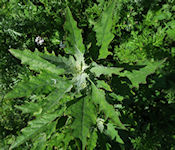
Family Description: Aizoaceae, commonly known as the ice plant family, is a diverse group of mostly succulent, dicotyledonous flowering plants within the order Caryophyllales. It includes around 135 genera and over 1,800 species, with the vast majority endemic to arid and semi-arid regions of southern Africa.
Members are typically annual or perennial herbs or subshrubs, often with prostrate or mat-forming growth habits. Stems may be erect or creeping, and many species exhibit sympodial branching. Leaves are usually opposite or alternate, simple, and succulent, with entire margins and no stipules. A distinctive feature is the presence of epidermal bladder cells, which give many species a glistening, crystalline appearance—hence the name “ice plants.”
Flowers are actinomorphic, bisexual, and often solitary or in cymose inflorescences. The perianth typically consists of five sepals, sometimes more, and numerous petaloid staminodes that mimic petals. True petals are absent. Stamens are numerous and may be arranged in whorls or bundles. The ovary is inferior to half-inferior, with axile or parietal placentation.
Fruits are usually capsular, often hygrochastic—opening when wet to disperse seeds via a jet-like mechanism. Seeds are small, numerous, and adapted for rapid germination in ephemeral conditions.
Family Description: Amaranthaceae is a large and diverse family of flowering plants within the order Caryophyllales, comprising approximately 165 genera and over 2,000 species. Members range from annual and perennial herbs to subshrubs, shrubs, and a few small trees. They are widely distributed, with a strong presence in arid, saline, and disturbed habitats.
Leaves are typically simple, alternate or opposite, and exstipulate, often entire and sometimes succulent or hairy. Many species contain betalain pigments, which can impart red or purple coloration to vegetative parts. Stems may be herbaceous or woody, and some taxa exhibit anomalous secondary growth.
Flowers are generally small, actinomorphic, and bisexual or unisexual, often aggregated into dense inflorescences such as spikes or panicles. Each flower is subtended by bracts and bracteoles. The perianth consists of 1–5 tepals, usually herbaceous or scarious. Stamens number 1–5 and are inserted on a hypogynous disc. The ovary is superior, unilocular, and formed from 1–3 fused carpels, typically with a single basal ovule.
Fruits vary widely—utricles, capsules, berries, or nutlets—and seeds are usually small, with a curved embryo and little or no endosperm. Many species utilize C4 photosynthesis, contributing to their success in hot, dry environments.
Suaeda fruticosa subsp. vera (Gmel.) Maire & Weiller
Shrubby Seablite, Alkali Seablite
Swejda
Jun-Oct
Normal Profile with
images.
BASELLACEAE Moq.-Tand. ( Basella Family )
Subfamalies: nil.
Family Description: Basellaceae is a small family of flowering plants within the order Caryophyllales, comprising about four genera and roughly 15 to 25 species. These are primarily herbaceous, perennial vines native to tropical and subtropical regions, especially in the New World.
Members are typically climbing or trailing plants, often with fleshy stems and leaves. Leaves are simple, alternate or opposite, exstipulate, and entire-margined, with considerable variation in shape even within a single species. The stems may be twining or sprawling, and some species develop tuberous rootstocks or aerial tubers for vegetative reproduction.
Inflorescences are usually axillary or terminal racemes or spikes, bearing small, actinomorphic, bisexual flowers. The perianth is petaloid, composed of 4 to 5 tepals, often fused at the base. Stamens are typically 5, opposite the tepals, and the ovary is superior, unilocular, with a single basal ovule. The style is simple or bifid, and the stigma is capitate or lobed.
Fruits are achenes or utricles, often enclosed by the persistent perianth. Seeds are endospermic with a curved embryo.
Notable genera include Basella (e.g., Basella alba, Malabar spinach), Anredera, Ullucus, and Tournonia.
Family Description: Cactaceae, commonly known as the cactus family, is a striking group of succulent, perennial flowering plants within the order Caryophyllales. It includes around 127 genera and nearly 2,000 species, primarily native to the Americas, from Canada to Patagonia, with Mexico as a major center of diversity.
Most cacti are adapted to arid and semi-arid environments, exhibiting thick, fleshy stems that store water and carry out photosynthesis. A defining feature is the presence of areoles—specialized, cushion-like structures from which spines, flowers, and branches emerge. These areoles distinguish cacti from other succulents.
Leaves are typically absent or reduced to spines, minimizing water loss and deterring herbivores. Only a few genera, like Pereskia, retain broad, functional leaves. Stems may be ribbed or fluted, allowing expansion during water uptake. Many species use crassulacean acid metabolism (CAM) to photosynthesize efficiently while minimizing water loss.
Flowers are often large, showy, and bisexual, with numerous tepals and stamens. They are usually solitary and arise from areoles. The ovary is inferior, and fruits are typically berries, containing numerous seeds.
Family Description: Casuarinaceae, commonly known as the she-oak or beefwood family, is a fascinating group of dicotyledonous flowering plants in the order Fagales, comprising about 4 genera and 90+ species. Native to Australia, Southeast Asia, eastern Africa, and the Pacific Islands, these plants are well-adapted to dry, nutrient-poor soils, often forming part of coastal or arid ecosystems.
Most members are trees or shrubs, either monoecious or dioecious, with a distinctive equisetoid appearance—their green, jointed, photosynthetic branchlets resemble horsetails (Equisetum). True leaves are minute, scale-like, and arranged in whorls at the nodes, forming a toothed sheath around the branchlets.
Male flowers are tiny and borne in catkin-like spikes at the tips of branchlets, each consisting of a single stamen and a pair of bracteoles. Female flowers are grouped in dense, globular heads, which mature into woody, cone-like infructescences composed of hardened bracteoles enclosing winged nuts (samaras). The ovary is bicarpellary, unilocular, and superior, with two long stigmas.
Pollination is anemophilous (wind-driven), and the plants often form symbiotic root nodules with Frankia bacteria, enabling nitrogen fixation—a key adaptation to poor soils.
Family Description: Nyctaginaceae, commonly known as the four o’clock family, exhibits several distinctive botanical features that set it apart within the Caryophyllales. The family is best recognized for its reduced, often inconspicuous true flowers that typically lack a distinct perianth. Instead, colorful and persistent bracts or bracteoles serve as the primary attractants for pollinators, lending the inflorescences a striking ornamental quality despite their underlying simplicity.
Vegetatively, species in Nyctaginaceae generally possess simple, alternate leaves that are frequently asymmetric and devoid of stipules. Their stems often display noticeable nodal swellings, contributing to the unique structural architecture of the plants. One particularly noteworthy reproductive adaptation is the development of an anthocarp—a structure in which the persistent perianth fuses with the fruit following fertilization. This modified fruiting mechanism aids in seed dispersal and enhances the family’s ecological success.
Family Description: Phytolaccaceae, commonly known as the pokeweed family, is a small group of flowering plants within the order Caryophyllales. The family includes a handful of genera—most notably Phytolacca—which showcase a range of growth habits from herbaceous perennials to woody shrubs and, in some cases, small trees. The leaves are typically arranged alternately or spirally, are simple with entire margins, and often exhibit a glabrous to sparsely pubescent texture.
Flowering structures in Phytolaccaceae are usually organized in racemes or occur singly within leaf axils. The flowers themselves are modest and actinomorphic, with a calyx composed of a few free sepals and a corolla that may be free or only slightly fused. The superior ovary develops into a fleshy, berry-like fruit that matures to reveal numerous small seeds—a feature that likely aids in vertebrate-mediated dispersal. Species in this family are adapted to a variety of habitats, ranging from moist woodlands to disturbed soils, illustrating both their ecological plasticity and evolutionary resilience.
Family Description: Portulacaceae, commonly referred to as the purslane family, is a group traditionally recognized for its succulent, herbaceous species in the order Caryophyllales. Historically, the family was thought to include up to 15 genera and around 500 species; however, modern molecular studies have greatly narrowed its circumscription so that it now essentially comprises only the genus Portulaca (with roughly 115 species). Plants in this redefined family typically feature fleshy, often glabrous leaves that form basal rosettes—a key adaptation for water storage in arid or saline environments. The flowers tend to be small and structurally simple, usually lacking distinct true petals. Instead, they often display petal-like sepals that are sometimes accompanied by a pair of green bracteoles, lending a subtle ornamental quality to the blooms.
Widely distributed in disturbed soils, open habitats, and even cultivated gardens, members of Portulacaceae are ecologically versatile. A well-known example is Portulaca oleracea, an edible species prized not only for its culinary uses—being a rich source of omega-3 fatty acids—but also for its medicinal properties. Despite the shifting boundaries in its taxonomic treatment (with many taxa formerly placed within Portulacaceae now reassigned to families such as Montiaceae, Didiereaceae, Anacampserotaceae, or Talinaceae), the distinctive succulence and adaptive morphology of these plants continue to underscore their evolutionary success in challenging, water-limited environments.
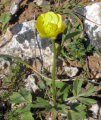











_t0.jpg "Malephora species (hybrid) / Fig-Marigold")