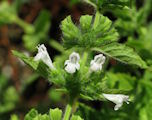
Family Description: Cannabaceae, commonly known as the hemp family, is a small but ecologically and economically significant group of flowering plants within the order Rosales. It includes about 11 genera and roughly 170 species, with a nearly worldwide distribution, especially in temperate regions.
Members range from herbaceous annuals (Cannabis) and twining vines (Humulus) to deciduous trees and shrubs (Celtis, Trema). Leaves are typically simple or palmately compound, arranged oppositely or in spirals, and always stipulate. Many species contain cystoliths (calcium carbonate crystals) and may have laticifers.
Plants are often dioecious, bearing unisexual flowers on separate individuals. Flowers are small, actinomorphic, and apetalous, adapted for wind pollination. The calyx is reduced, and the corolla is absent. Male flowers usually have five stamens, while female flowers have a superior, unilocular ovary formed from two fused carpels.
Fruits are typically achenes or drupes, often enclosed by a persistent bracteole. Seeds are endospermic with a straight embryo.
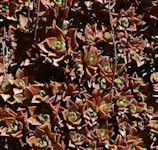
Family Description: Crassulaceae, commonly known as the stonecrop or orpine family, is a fascinating group of succulent flowering plants in the order Saxifragales. It includes about 30 to 35 genera and roughly 1,400 species, making it the largest family in its order. These plants are distributed worldwide—from tropical to boreal zones—but are especially abundant in arid and rocky habitats, such as those in Southern Africa and the Mediterranean.
Members of Crassulaceae are typically herbaceous perennials or low shrubs, though some are annuals or aquatic. Their most distinctive feature is their succulent leaves, which store water and often form rosettes. These leaves are usually simple, entire, and exstipulate, and the stems often have swollen nodes. Many species exhibit Crassulacean Acid Metabolism (CAM), a photosynthetic adaptation that allows them to conserve water by opening stomata at night.
The flowers are bisexual, actinomorphic, and usually 4- or 5-merous, with sepals, petals, stamens, and carpels often in equal numbers. The sepals and petals may be free or fused at the base, and the stamens are typically twice the number of petals. The ovary is superior, composed of 3 to 10 free carpels, each with a nectar gland at its base. Fruits are usually follicles, and seeds are often small and numerous.
Family Description: Cynomoriaceae is a small, highly specialized family of holoparasitic flowering plants, meaning its members lack chlorophyll and rely entirely on host plants for nutrients. The family contains a single genus, Cynomorium, with species like Cynomorium coccineum—commonly known as the Maltese fungus or desert thumb—found in arid and semi-arid regions across the Mediterranean, Middle East, and Central Asia.
These plants are fleshy, reddish-brown, and achlorophyllous, emerging from a large underground rhizome that attaches to host roots via numerous haustoria. Common hosts include species from Chenopodiaceae, Asteraceae, Tamaricaceae, Fabaceae, and Plumbaginaceae.
The visible part of the plant is actually a club-shaped inflorescence, densely packed with minute, unisexual or bisexual flowers. Male flowers have 4-locular anthers and distinctive clavate sepals, while female flowers possess a unilocular ovary with 2–3 syncarpous carpels and a bifid or trifid style. Pollination is typically by flies, and the fruit is a small, indehiscent nut-like structure containing a single seed.
Cynomoriaceae is cytologically notable for its bimodal karyotype (2n = 28), with both macro- and microchromosomes. Its unusual morphology and parasitic lifestyle have made it a subject of interest in evolutionary and ecological studies.
Family Description: Elaeagnaceae, commonly known as the oleaster family, is a small but ecologically and economically notable group of flowering plants in the order Rosales. It comprises about 60 species across three genera: Elaeagnus, Hippophae, and Shepherdia. These are mostly shrubs or small trees, often found in temperate and subtropical regions of the Northern Hemisphere, including parts of Asia, Europe, and North America.
Members of this family are typically thorny, with simple, alternate leaves that are often covered in silvery or rusty scales or hairs, giving them a distinctive sheen. This adaptation helps reduce water loss, making many species well suited to dry (xeric) or saline (halophytic) environments. A remarkable trait of Elaeagnaceae is their ability to fix atmospheric nitrogen through symbiosis with Frankia bacteria in root nodules, which enhances their role in soil reclamation and ecological restoration.
The flowers are usually unisexual or bisexual, small, and lack petals, consisting instead of a tubular calyx formed by fused sepals. Male flowers typically have 4–8 stamens, while female flowers contain a superior ovary with a single carpel and ovule. The fruit is either a drupe-like structure or achene, enclosed by the fleshy, persistent calyx, and contains a single seed with little or no endosperm and thick, fleshy cotyledons.
Notable species include Elaeagnus angustifolia (Russian olive), Hippophae rhamnoides (sea buckthorn), and Shepherdia argentea (silver buffalo berry). These are valued for their ornamental appeal, edible fruits, and medicinal or ecological uses.
Family Description: Haloragaceae, commonly known as the watermilfoil family, is a small but morphologically diverse group of flowering plants within the order Saxifragales. It includes about 8 genera and roughly 100 species, with a distribution that spans temperate and subtropical regions, particularly in the Southern Hemisphere.
Members of Haloragaceae range from submerged aquatic herbs to woody shrubs and small trees. Leaves are typically alternate, opposite, or whorled, and in aquatic species like Myriophyllum, they are often finely dissected or pectinate, maximizing surface area for underwater photosynthesis. Stipules are generally absent, though some species may have small intravaginal scales.
The flowers are usually small, actinomorphic, and unisexual or hermaphroditic, borne singly or in inflorescences such as spikes or panicles. Floral parts are often in multiples of four, though variation exists. The perianth may be reduced or absent, especially in submerged taxa. Stamens typically number 2 to 8, and the ovary is inferior, composed of 2 to 4 fused carpels, each with a single ovule.
Fruits are diverse, including schizocarps, nuts, or drupes, often breaking into one-seeded segments. These adaptations reflect the family's ecological breadth—from aquatic to terrestrial habitats.
Family Description: Lythraceae, commonly known as the loosestrife family, is a diverse family of flowering plants within the order Myrtales. The family encompasses around 31 genera and roughly 620–650 species, with members ranging from herbaceous plants and small shrubs to trees. They are predominantly found in warmer regions of both the Old and New Worlds, with particular diversity in South America, Africa, and parts of Asia.
Morphologically, Lythraceae species typically possess simple leaves arranged oppositely or in whorls, with entire margins and well-defined venation. Many members of the family display glandular hairs or other surface textures that can contribute to a distinctive aroma. The flowers are usually actinomorphic (radially symmetric) and bisexual, often featuring a well-developed hypanthium—an often cup-like structure at the base of the flower. A characteristic trait in the family is that the petals are crumpled while in bud, and they usually occur in multiples of four or six. Stamens tend to be numerous, frequently occurring in two whorls that are roughly twice the number of petals, and the superior ovary may exhibit axile placentation. The fruit is typically a dry, dehiscent capsule that splits open to release its seeds.
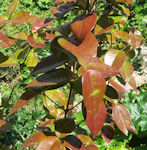
Family Description: Myrtaceae is a family of woody angiosperms in the order Myrtales that comprises a diverse array of trees, shrubs, and occasionally subshrubs. Members of the family are typically evergreen, with coriaceous leaves that are simple—often arranged alternately or occasionally in opposite pairs—and bear numerous essential oil glands. These oil-containing punctations give the foliage a distinctive aroma and are a diagnostic feature of the family.
The flowers are generally actinomorphic and bisexual, with a tendency toward a pentamerous arrangement in which the showy, imbricate petals are accompanied by a conspicuous number of stamens. In many species, the stamens form an outer ring that can be much more prominent than the petals themselves. The superior ovary is composed of free or partially fused carpels, and the resulting fruit may be a fleshy berry, a dry capsule, or sometimes a follicle, depending on the genus. Such morphological diversity in floral and fruit structures reflects the adaptive radiation and ecological versatility of the family, which has a broad distribution in tropical and warm-temperate regions.
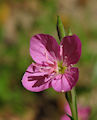
Family Description: Onagraceae, commonly known as the evening primrose or willowherb family, consists of roughly 650 species distributed among about 17 genera. These predominantly herbaceous plants, though some shrubs and small trees occur, are well adapted to a range of habitats from temperate woodlands to arid deserts and wetlands. The leaves are usually simple, alternately arranged, and can be lanceolate or ovate with entire or slightly toothed margins.
The floral structure is notably uniform within the family. Most species exhibit actinomorphic flowers with four free sepals and four free petals arranged in a regular pattern. Numerous stamens typically surround a central gynoecium, and in many members the ovary is inferior—a feature that significantly influences fruit development. Following pollination, the inferior ovary generally develops into a capsule that dehisces to release small, numerous seeds.
Family Description: Rhamnaceae, commonly known as the buckthorn family, is a significant group of flowering plants classified within the order Rosales. The family comprises approximately 55 to 60 genera and around 900 to 950 species distributed worldwide, although its members are particularly abundant in subtropical and tropical regions.
Members of Rhamnaceae are typically trees, shrubs, or climbing plants. Their leaves are generally simple and arranged alternately (or less frequently oppositely) and often bear stipules that, in certain genera, may develop into spiny structures providing a defensive function. The flowers tend to be small and radially symmetrical, featuring five separate sepals and five free petals, with stamens usually numbering in a similar range. A notable floral characteristic in many members of this family is the presence of an intrastaminal disk, which can be an important taxonomic marker.
The fruits of Rhamnaceae are diverse—ranging from drupes and berries to, in some cases, nuts—and are frequently adapted for animal-mediated dispersal. Several species in the family, such as those in the genus Ziziphus, produce edible fruits (e.g., the Chinese jujube) and have economic significance, not only in agriculture but also in traditional medicine and timber production. The bark of certain species, like Rhamnus purshiana, has been historically used to produce cascading sagrada, a natural laxative.
Ziziphus zizyphus (L.) H.Karst. - Historically established synonym widely adopted in Maltese flora
Jujube, Chinese date
Żinżel
May-Jun
Normal Profile with
images.
ROSACEAE L.
Rose Family
Subfamalies: Rosoideae, Dryadoideae, Maloideae
Family Description: Rosaceae, commonly known as the rose family, is one of the largest and most economically and ornamentally important families of flowering plants. The family is estimated to include around 4,800 species distributed in over 90 genera, though these numbers can vary among different sources.
Members of Rosaceae display a remarkable diversity of growth forms, including herbaceous perennials, shrubs, trees, and climbers. A defining feature of the family is its floral structure: most flowers possess five free sepals and five free petals arranged around numerous stamens and a central carpel. Additionally, many genera exhibit a hypanthium—a cup-like fusion of the basal parts of the sepals, petals, and stamens—that plays a significant role in the development of various fruit types.
Traditionally, Rosaceae has been divided into several subfamilies based primarily on the type of fruit produced. For example, the Amygdaloideae (sometimes referred to as Prunoideae) include species that form drupes such as peaches and cherries; the Maloideae comprise pomes like apples and pears; whereas the Rosoideae are characterized by aggregate fruits such as raspberries, strawberries, and roses. Recent phylogenetic studies have led to ongoing revisions and alternative classification schemes, reflecting the complex evolutionary history of the family.
Economically, the impact of Rosaceae cannot be overstated—it provides many of the fruits that are cornerstones of global agriculture and also contributes extensively to horticulture and landscaping with ornamental plants such as roses and flowering cherries. This combination of ecological versatility, evolutionary innovation, and cultural significance marks Rosaceae as a family of enduring interest to botanists and plant enthusiasts alike.
Family Description: Saxifragaceae is a family of flowering plants that, following modern molecular studies, is now understood to include around 35 genera and roughly 640 species. These are predominantly herbaceous perennials native to temperate regions, many of which inhabit rocky or alpine habitats where they frequently form basal rosettes of simple or lobed leaves. Historically, the family was defined much more broadly, including a diverse array of taxa that have since been reclassified based on genetic evidence.
The flowers in this family are typically small and radially symmetrical, usually featuring five sepals and five petals—often with their bases fused to form a hypanthium. The fruit is generally a dry capsule that dehisces to release numerous tiny seeds, an adaptation that aids survival in challenging environments. Many saxifrage species are popular in rock gardens and natural landscapes due to their attractive foliage and delicate blooms, underscoring both their ecological and horticultural value.