Family Description: Apiaceae, also known as the carrot or parsley family, is a large and distinctive group of aromatic, herbaceous dicotyledons within the order Apiales. It includes over 400 genera and nearly 3,800 species, with a cosmopolitan distribution, especially abundant in temperate regions of the Northern Hemisphere.
Plants are typically annual, biennial, or perennial herbs, though some are shrubs or small trees. Stems are often fistular (hollow) and ribbed. Leaves are alternate, usually compound and pinnately or ternately dissected, with sheathing petiole bases and no stipules. The foliage often emits a strong aroma due to the presence of secretory canals containing essential oils.
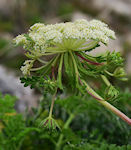
The hallmark of the family is the compound umbel inflorescence, often subtended by involucral bracts. Flowers are actinomorphic, epigynous, and pentamerous, with five sepals (often reduced), five petals, and five stamens. The inferior ovary is bicarpellary and syncarpous, with a prominent nectariferous disc (stylopodium) at the summit.
Fruits are typically schizocarps, splitting into two mericarp segments (a cremocarp), each containing a single seed. Mericarps often bear ridges and oil ducts (vittae). Seeds are endospermic with a curved embryo.
Apiaceae includes both culinary staples (e.g., Daucus, Apium, Coriandrum) and toxic species (e.g., Conium, Cicuta), making identification critical in both botanical and ethnobotanical contexts.
Ammi visnaga (L.) Lam. - Historically established synonym widely adopted in Maltese flora
Toothpick-plant, Tooth pickweed, Bishop's weed
Busnaga, Visnaga
Apr-Jun
Normal Profile with
images.
ARALIACEAE Juss.
Ginseng or Aralia Family
Subfamalies: Aralioideae, Hydrocotyloideae
Family Description: Araliaceae, commonly known as the ginseng or ivy family, is a morphologically diverse group of flowering plants within the order Apiales. It includes approximately 40 to 50 genera and over 1,500 species, ranging from woody trees and shrubs to lianas and a few herbaceous forms. The family is predominantly tropical, though several species extend into temperate regions.
Vegetatively, members typically have alternate, simple or compound leaves, often palmately or pinnately divided, with long petioles and sheathing bases. Stipules are absent. Many species contain aromatic essential oils, and some exhibit prickles or spines. The stems are usually cylindrical and may be woody or herbaceous.
Inflorescences are characteristically compound umbels, though variations such as racemes or heads also occur. Flowers are actinomorphic, bisexual or unisexual, and typically pentamerous, with five sepals, five petals, and five stamens. The inferior ovary is syncarpous, usually 2- to 5-locular, with a single ovule per locule and a prominent nectariferous disc at the summit.
Fruits are generally fleshy drupes or berries, often containing multiple seeds. Seeds are endospermic with a small, straight embryo.
Notable genera include Panax (ginseng), Hedera (ivy), Aralia, and Schefflera.
Family Description: Elaeagnaceae, commonly known as the oleaster family, is a small but ecologically and economically notable group of flowering plants in the order Rosales. It comprises about 60 species across three genera: Elaeagnus, Hippophae, and Shepherdia. These are mostly shrubs or small trees, often found in temperate and subtropical regions of the Northern Hemisphere, including parts of Asia, Europe, and North America.
Members of this family are typically thorny, with simple, alternate leaves that are often covered in silvery or rusty scales or hairs, giving them a distinctive sheen. This adaptation helps reduce water loss, making many species well suited to dry (xeric) or saline (halophytic) environments. A remarkable trait of Elaeagnaceae is their ability to fix atmospheric nitrogen through symbiosis with Frankia bacteria in root nodules, which enhances their role in soil reclamation and ecological restoration.
The flowers are usually unisexual or bisexual, small, and lack petals, consisting instead of a tubular calyx formed by fused sepals. Male flowers typically have 4–8 stamens, while female flowers contain a superior ovary with a single carpel and ovule. The fruit is either a drupe-like structure or achene, enclosed by the fleshy, persistent calyx, and contains a single seed with little or no endosperm and thick, fleshy cotyledons.
Notable species include Elaeagnus angustifolia (Russian olive), Hippophae rhamnoides (sea buckthorn), and Shepherdia argentea (silver buffalo berry). These are valued for their ornamental appeal, edible fruits, and medicinal or ecological uses.
Family Description: Dwarf shrubs to small trees; leaves simple, exstipulate, usually evergreen. Flowers actinomorphic (rarely slightly zygomorphic), in racemes or umbels, or solitary or in clusters in the leaf-axils. Petals usually connate. Stamens twice as many as petals (rarely fewer), inserted on the receptacle or disc, but sometimes adnate to the extreme base of the corolla and falling with it; anthers usually opening by pores; pollen grains usually in tetrads. Ovary superior (rarely inferior); placentation axile; style single. Fruit a capsule, berry or drupe.
Family Description: Pittosporaceae is a small family of flowering plants within the order Apiales, comprising around nine genera and roughly 200–240 species. These plants are predominantly woody, manifesting as trees, shrubs, or twining lianas, and are chiefly distributed across warm temperate to tropical regions of the Old World, such as Australia, Southeast Asia, and the Pacific Islands.
Members of this family typically display evergreen foliage with simple leaves that are arranged alternately or in slight opposition. The leaves usually have entire margins and a leathery texture, with pinnate venation that lends structural clarity and durability in diverse habitats. The inflorescences are often compact, bearing actinomorphic flowers that exhibit pentamerous symmetry; each flower usually features five imbricate sepals and five free petals. Stamens are generally equal in number and do not markedly differ from one another in size or form. The superior ovary, composed of free carpels, gives rise to a fruit—often a capsule or a berry-like structure—that, upon maturation, releases seeds enrobed in a sticky exudate. This adhesive coating enhances seed dispersal by facilitating attachment to the fur or feathers of animals, thereby promoting the colonization of new areas.
Family Description: Primulaceae, commonly known as the primrose family, is a widespread group of flowering plants now classified within the order Ericales. The family, as recognized in its modern sense, comprises around 58 genera and nearly 2,600 species distributed worldwide—from temperate and alpine regions to subtropical environments. Members of Primulaceae include herbaceous perennials, annuals, and even some shrubs or small trees. Many species form basal rosettes of simple leaves that are often alternate and bear toothed or entire margins.
A distinctive feature of the family is seen in its floral morphology. Flowers are typically bisexual and can display either actinomorphic or zygomorphic symmetry. They often exhibit a sympetalous (fused) corolla, and many species are haplostemonous—meaning the number of stamens equals the number of petals, with stamens usually positioned opposite the petals. The flowers generally lead to the formation of a superior ovary with free central placentation, and the fruit is commonly a capsule that releases numerous small seeds upon dehiscence.
Advances in molecular phylogenetics have led to notable taxonomic revisions, with several groups (such as those formerly treated as Maesaceae, Myrsinaceae, and Theophrastaceae) being subsumed into a broader circumscription of Primulaceae (sometimes referred to as Primulaceae sensu lato). Despite these changes, many of the traditional morphological features—like the basal leaf rosette and the characteristic floral traits—remain central to identifying members of the group. Genera such as Primula (the true primroses) and Cyclamen are not only key to the family’s diversity but also hold significant ornamental and, in some cases, medicinal value.
Beyond their horticultural appeal, primrose species play important ecological roles. They often act as pioneer plants in disturbed habitats and contribute to the biodiversity of flora in woodland edges, meadows, and rocky outcrops. Their seasonal blooms are an early herald of spring, making them a subject of both scientific interest and cultural significance