Family Description: Cyperaceae, commonly known as the sedge family, is a large and globally distributed group of monocotyledonous flowering plants in the order Poales. It includes around 90–100 genera and over 5,500 species, making it one of the ten largest families of flowering plants. Sedges are especially abundant in wetlands, marshes, and damp meadows, though they also thrive in alpine, arid, and coastal habitats.
These plants are typically herbaceous perennials, though some are annuals. A hallmark feature is their solid, often triangular stems—a trait captured in the botanical mnemonic “sedges have edges.” Leaves are simple, linear, and grass-like, arranged in three ranks, with closed sheaths and no ligules. Many species spread via rhizomes or tubers, allowing them to form dense colonies.
The inflorescence is usually a spikelet, composed of small, inconspicuous flowers, each subtended by a glume. Flowers are often unisexual or bisexual, hypogynous, and monochlamydeous—lacking a true perianth, though some have scales or bristles in its place. Stamens typically number 1 to 3, and the gynoecium is bicarpellary or tricarpellary, syncarpous, with a superior, unilocular ovary and a single basal ovule. The stigmas are often feathery, aiding in wind pollination.
The fruit is a nut or achene, often trigonous (three-angled), and the seeds are endospermic, with a small, straight embryo. Some species, like Cyperus papyrus, have historical significance—papyrus was made from its pith—while others, like Cyperus esculentus (tigernut), are cultivated for food.
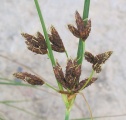
Holoschoenus vulgaris Link - Historically established synonym widely adopted in Maltese flora
Round-headed clubrush
Simar tal-boċċi
Feb-Jun
Normal Profile with
images.
JUNCACEAE Juss.
Rush Family
Subfamalies: Juncadeae, Luzuloidea
Family Description: Juncaceae, commonly known as the rush family, is a group of monocotyledonous flowering plants within the order Poales. It includes about 8 genera and approximately 460 species, most notably the genus Juncus, which gives the family its name. These plants are widespread, especially in temperate and subarctic regions, and are often found in wetlands, marshes, and other moist or nutrient-poor habitats.
Morphologically, members of Juncaceae are herbaceous perennials or annuals, often with creeping rhizomes and erect, cylindrical or flattened stems. The leaves are typically basal or cauline, alternate, and tristichous (arranged in three vertical rows), with sheathing bases and often lacking a distinct blade. In some genera, like Luzula, the leaves are flat and bear long, silky hairs.
The flowers are small, actinomorphic, and bisexual, usually arranged in cymose inflorescences or dense heads. They possess six papery tepals in two whorls, often greenish, brown, or purplish, and six stamens (though this can vary). The ovary is superior, tricarpellary, and syncarpous, developing into a dry, dehiscent capsule that splits to release numerous small seeds.