| |
|
 | |
| Online Flora of the Maltese Islands by Stephen Mifsud |

|
| |
|
|
 |  |  |  |
| External Links: |
|
Convolvulus althaeoides subsp. tenuissimus
(Silvery Mallow-Leaved BindWeed) |
Convolvulus althaeoides subsp. tenuissimus (CONVOLVULACEAE.)
Images for this profile are taken from the Maltese Islands after year 2000.
Website launch: Oct-2002
Taxonomic update: Aug-2026
Code update: Jul-2026 |
|
| Nomenclature |
Species name : | Convolvulus althaeoides subsp. tenuissimus (Sm.) Stace | Authority : | James Edward Smith, United Kingdom, (1759 - 1828) ;
Jules Aimé Battandier , France, (1848–1922) | Synonyms :
(basionym or principal syn.) |
Convolvulus elegantissimus
Mill.
Synonym that was used for long in Malta:
Convolvulus elegantissimus
Miller
Full list of synonyms :
[Euro+Med]
[WFO]
[IPNI]
[POWO]
[Catalogue of Life]
[Worldplants.de]
|
Plant Family : | | English name(s) : | Silvery Mallow-Leaved BindWeed, Dissected Mallow-Leaved BindWeed | Maltese name(s) : | Leblieba tax-xagħri ċar, Leblieba tax-xagħri tal-werqa fiddenija | Status for Malta : | Indigenous. Present on the Maltese islands before man | Name Derivation : |
Convolvulus: from the Latin word convolvere, meaning to twine around, referring to the twining habit of the stem of most plants in this genus. (Latin origin); 2. from the Latin "convolvere", meaning to twine around, referring to its stem`s twining habit. (Latin);.
althaeoides subsp. tenuissimus: (); 2. Elegant, pretty - referring to the beautiful flower or the whole plant in general. (Latin).
| Remarks : | |
|
| Morphology and structure |
PLANT STRUCTURE: |
Character | Growth Form | Branching | Surface |
Description | Prostrate & coiledProstrate & coiled Stem trailing on the ground, walls or vegetation and can climb for a short distance over neighbouring plants. | | |
General
Picture |  |  |  |
|
LEAVES: |
Character | Arrangement | Attachment | Venation |
Description | | | |
General
Picture |  |  |  |
| |
Character | Leaf Shape | Leaf Margin | Remarks |
Description | | | |
General
Picture |  |  | |
|
FLOWERS: |
Character | Colour | Basic Flower Type | No. of Petals | No. of Sepals |
Description | Pink (With a white center). | | 5 (Fused together). | 5 |
General
Picture | |  | | |
| |
Character | Inflorescence | Description | Ovary | Stamens |
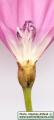
Description | | Flower consists of 5 small overlapping sepals and a large flower with its 5 petals entirely fused together to form a trumpet shaped corolla. It has a pink colour with a white centre from which the 5 stamens and central pistil with 2-parted stigma comes out. | | |
General
Picture |  | |  |  |
| |
Character | Scent | Average Flower Size | Pollen Colour | Other Notes |
Description | YES Possess a noticeable sweet vanilla-like scent. | 45-55mm | White | - |
|
SEEDS: |
Character | No. Per Fruit | Shape | Size | Colour |
Description | 1-4 (Maximum 4 per fruit). | Oval Shape of a lemon. | 4-5mm | Dark Brown |
General
Picture | | | | |
|
FRUIT AND OTHER BOTANICAL DATA: |
Character | Fruit Type | Colour of Fruit | Subterranean Parts | Other Notes |
Description | | Green Turns reddish brown when ripe. | | - |
General
Picture |  | |  | |
|
|
| Plant description and characters | |
Life Cycle: | Perennial. |
Growth Form: | Hemicryptophyte (perennial herbaceous plants with vegetative buds close to the ground) |
Habitat: | Arid rocky ground at field margins, derelict fields, rubble walls and waysides, footpaths, and disturbed ground close to agricultural areas. |
Frequency: | Frequent |
Localities in Malta: | Frequent in several places around the Maltese Islands such as at Dingli, Rabat, Siggiewi, Mellieha, Mistra, Wied il-Ghasel, Wied Babu etc. |
Plant Height: | Prostate plant, only about 15cm high, but its stem can extend upwards along a vertical support up to 1m - 2m. |
| Mar-Jun |
Protection in Malta: | Not legally protected till the last update of this website (22/Aug/2025) |
Red List 1989: | Not listed in the Red Data Book of the Maltese Islands |
Poison: | |
This perennial plant, produce prostrate stems with the ability to intertwine and coil so as to climb along with other upright objects, namely neighbouring plants. The stem is very thin and is silvery due to the presence of very fine, shiny, white hairs. It produces leaves and flowers at one side of the stem, the other side being the part resting on the ground.
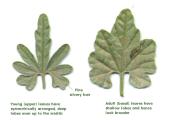
The leaves are quite attractive in being symmetrically lobed and silvery-looking especially in sunlight. The leaf shape is generally heart-shaped in outline but it is so much lobed that this shape is somehow lost. The deepness of lobes vary. The older and basal leaves are unlobed or have shallow lobes and so the heart-shape structure can be observed. The leaves along the stem then gets gradually more lobed and the uppermost leaves consists of deep, very slender leaf lobes, looking like a few thin finger-like projections. The leaves lack stipules and have slender stalks of various lengths.
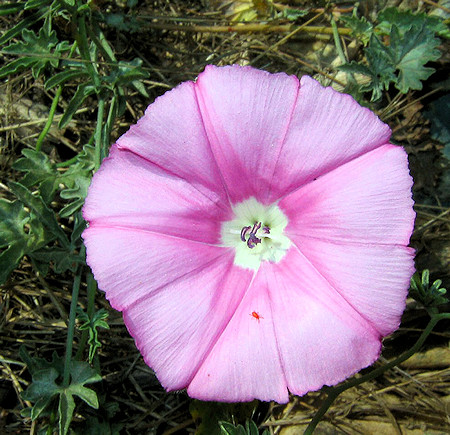
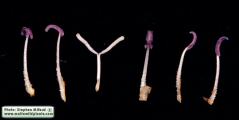
The flowers have long pedicels, longer than the leaves, probably to surpass and stand out from the leaves. They contain 5 small ovate sepals which persists during the fruit stage. The pink/lilac flowers are trumpet shaped (petals are fused), zygomorphic with 5 planes of symmetry. they are about 50mm in diameter. The flower have a characteristic white centre from which the 5 stamens and central pistil comes out. Each stamen consists of a white filament and an indigo anther. The pistil consists of a very small inferior ovary, a white style and a stigma, that is split into 2 parts.
The fruit is a spherical dehiscent capsule with a pointed tip. The capsule is about 8mm in diameter and green which turns reddish brown when getting ripe. It will split open and drop the 4 brown seeds (about 4mm in size) without any means of dispersion.
|
|
| Information, uses and other details |
Nomenclature and identification
There are at least two sub species of Convolvulus althaeoides, that are C. althaeoides subsp althaeoides and C. althaeoides subsp tenuissimus. The former is also referred to as Convolvulus althaeoides and the latter is referred to as Convolvulus elegantissimus. One important feature to distinguish the two (sub-)species is the centre part of the plant where the C. althaeoides has a darker centre (deep violet) from the rest of the corolla while C. elegantissimus have a whiter center. [300]
Nativity
This plant is native to the Mediterranean region including north Africa. [WWW-26]
Why it is difficult to extirpate the plant
Like many Convolvulus species, this plant is very difficult to get rid off and this is thanks to Its roots. Its roots run very deeply into the ground and extend over a large area. Furthermore the long roots are brittle and readily snap, and any part left in the ground will soon grow and send up shoots to the surface in a very short time. [WWW-03]
Personal Observations
Common habitants
While photographing these wild plants, many flowers had very small (perhaps less from 1 mm) bright-red insects which looked like mites. They are seen mostly at the very center of the flower and start running along the corolla when the flower is disturbed. Probably they can pass throgh the nectar holes of the flower to feed on the sugary nectar liquid. Click here for a photo of these insects on the flower [SM]
Perennial characteristic of the plant
Although this plant is seen for a couple of months during Spring / early Summer it is still described as a perennial, hence living all year round. This is due to the fact that the plant have living, underground, root-like rhizomes which remains 'dormant' during Autumn and Winter and shoots up when the climate rises to optimal temperature in Spring [SM]
Not much information has been found about this particular plant species. If you can supply further info to be included in this profile, please do not hesitate to email us pr by using the form found at the botom of this page. Full reference credits will be given accordingly. Thank you for your support!
|
|
| Links & Further literature
(0 papers) |

Google Web |

Google Images |

Google Scholar |

Research Gate |

Wikipedia |

JSTOR |

GBIF |

Med Checklist |

Cat. of Life |

EoL |

IPNI |

World Flora Online |

Plants of the World Online |

Vienna Virt. Herb. |

RBGE Herbarium |

KEW Herbarium |

MNHN |

Garden Database |

IUCN |

TROPICOS |
Kindly Email if there are papers and publications about local
studies or information about this species to be included in the list above.
|
| Photo Gallery (35 Images) |  |
 |
 |
 |
IMAGE: CNVEL-01 Photo of Flower . It has a lilac-pink colour, with a white centre. |
IMAGE: CNVEL-02 Photo of Flower. |
IMAGE: CNVEL-03 Photo of Flower. |
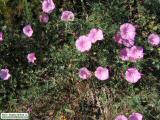
IMAGE: CNVEL-04 Photo of several trumpet shaped flowers. |
 |
 |
 |
 |
IMAGE: CNVEL-05 Photo of several flowers taken in May. |
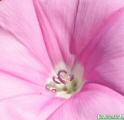
IMAGE: CNVEL-06 Close up photo of central part of flower. The white centre of the Convolvulus althaeoides subsp tenuissimus(= C. elegantissimus) is the distinctive feature from the C. althaeoides subsp. althaeoides ( = C. althaeoides) which have a darker violet centre. |
IMAGE: CNVEL-07 Magnified photo of flower's centre. It has 5 stamens, a central 2-parted style and 5 small holes which lead to the nectar stores. |
IMAGE: CNVEL-08 Magnified photo of flower's centre showing a common habitant of the plant - tiny red aphids. |
 |
 |
 |
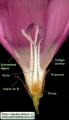 |
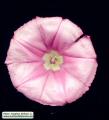
IMAGE: CNVEL-09 Scanned image of flower against a dark background. |
IMAGE: CNVEL-10 Scanned image of flower. |
IMAGE: CNVEL-11 Scanned image of Calyx - made up of 5 small, overlapping sepals - and the red-maroon buds pleated in a cylindrical shape. |
IMAGE: CNVEL-12 Annotated scanned image of flower reproductive organs. Few stamens and sepals have been removed. |
 |
 |
 |
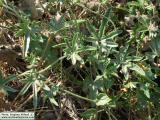 |
IMAGE: CNVEL-13 Scanned image against a dark background of central part of flower. Although it appears to be 4, actually there are 5 stamens - one is exactly behind another making them appear as one stamen. |
IMAGE: CNVEL-14 Scanned image of central part of flower. |
IMAGE: CNVEL-15 Scanned image of the 5 stamens and style+stigma. The stamens consists of white filaments and contrasting indigo anthers whereas the style and stigma is white. The stigma is divided into two similar parts. |
IMAGE: CNVEL-16 Photo of the lobed leaves in situ. |
 |
 |
 |
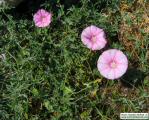 |
IMAGE: CNVEL-17 Photo of the lobed leaves in situ. |
IMAGE: CNVEL-18 Different morphology of leaves (heterophylly) at various locations along the trailing stems. The basal leaves are shallowly lobed, forming a broad entire leaf with a cordate base. The lobes on the leaves further up the stem become more distinct and isolated as small leaf segments, with the division reaching the midrib or petiole. |
IMAGE: CNVEL-19 Comparison of a basal (old) leaf and a leaf at the upper part of the stem, the former is broad and arrow shaped, the latter is deeply lobed. |
IMAGE: CNVEL-20 Photo of plant(s). |
 |
 |
 |
 |
IMAGE: CNVEL-21 Photo of several plants and their pink flowers. |
IMAGE: CNVEL-22 Photo of plant in its natural habitat, hence creeping along stones in waysides. |
IMAGE: CNVEL-23 Photo of plant along stones. |
IMAGE: CNVEL-24 Photo of twining stem along a dried stem of another plant which serves as support for the Convolvulus to spread or climb up. |
 |
 |
 |
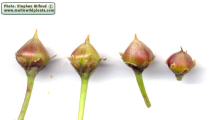 |
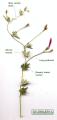
IMAGE: CNVEL-25 Scanned and annotated image of plant. Note that the leaves and flowers outgrows from one side of the stem (Unilateral outgrowths). |
IMAGE: CNVEL-26 Scanned image of plant against a dark background to show better the silvery appearance of the leaves and stem due to their fine shiny hairs. |
IMAGE: CNVEL-27 Scanned image of plant. |
IMAGE: CNVEL-28 Dehiscent (open by splitting up) capsules which turn reddish brown especially if exposed to direct sunlight. |
 |
 |
 |
 |
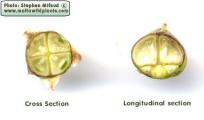
IMAGE: CNVEL-29 Transverse and longitudinal section through fruit capsules. As it is clearly shown, each fruit can hold 4 seeds. |
IMAGE: CNVEL-30 |
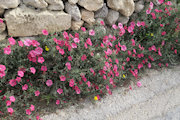
IMAGE: CNVEL-31 Plant climbing and covering a rubble wall with numerous deep purple flowers. |
IMAGE: CNVEL-32 Display of deep purple flowers on a plant (or more than one) covering a rubble wall. |
 |
 |
 |
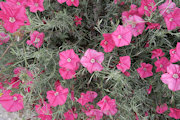
| IMAGE: CNVEL-33 Numerous flowers blooming in spring when the days get longer and warmer. |
IMAGE: CNVEL-34 Close up of purple flowers and silvery leaves in between. |
IMAGE: CNVEL-35 Close up of purple flowers with a white centre. |
IMAGE: CNVEL-36 - |
|

Sales and Donations

|
 |
Sales of seeds of wild plant from Malta: Seeds of selected wild plant species may be available for academic studies, research purposes, or personal use. Please note that not all species can be supplied or exported. Availability is subject to seasonal seed production, stock levels, and applicable regulations, including Maltese legislation and CITES requirements where relevant. Protected and endemic species cannot be sold (at least without the relevant environmental permits).
How it works: First, submit a quotation request by completing the Online Quotation Form (link provided on the right side of this table). Once your request has been reviewed, you will receive confirmation regarding seed availability, export eligibility (where applicable), pricing, and any transport charges. Payments are accepted by Revolut, bank transfer (IBAN), or PayPal only; credit and debit card payments are not accepted.
Please note that local orders are currently not being accepted. Seek Maltese nurseries and NGOs for local orders.
|
Online Quotation (Seeds)
|
 |
Buy Images: Purchase photographs from this extensive online collection of Maltese flora by Stephen Mifsud. Images are available at reasonable prices, with rates varying according to image size and resolution. Your purchase helps support the maintenance and development of this website. When placing an order, please note the image code displayed beneath each photograph on the corresponding species page, as this is required when completing the online order form. Images are normally supplied under a license agreement, with copyright retained by the author; however, the sale of copyright for exceptional images may be considered on request.
|
Online Purchase (Images)
|
 |
Support this ad-free website Kindly consider to support this website by giving a small donation which will help to cover some expenses needed to pay the webserver and domains, maintain the website without any adverts, upgrading the code, including more wild plants and photos, and adding further data amongst other developments. You can use the links on the right for direct donations to this website by PayPal or Revolut. Even a 5 or 10 Eur donation is appreciated. Remember this website was ad*free since its launch back in 2002 and has served as an environmental educational tool for over 20 years.
|
💙 Donate by PayPal
💳 Donate by Revolut
|
|
| Contribute Information or Report Errors |
Use this form to submit additional information about this species or to report any inaccuracies on this webpage.
If the information you provide is sourced from a book, journal, website, or any other publication, rather then your own information or experience, then please include the relevant reference or web address whenever possible. Your email address will be used solely for internal communication and will not be shared. We greatly appreciate reports of: taxonomic updates; species misidentifications; incorrect or outdated information, broken links, technical website issues, or any additional information specific to the plant in this webpage.
Your contributions help to improve the accuracy and quality of this website. Thank you! Fill any of the three sections (A/B/C) below: .
|
|
|
|
| | |