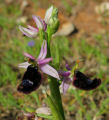
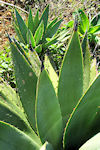
Subfamalies: Agapanthoideae (= Agapanthaceae family); Allioideae (= Alliaceae family); Amaryllidoideae (Amaryllidaceae family senso strico)
Family Description: Amaryllidaceae is a family of monocotyledonous, mostly bulbous perennial herbs within the order Asparagales. It includes approximately 70–75 genera and over 1,600 species, with a cosmopolitan distribution but a strong center of diversity in South Africa and South America.
Vegetatively, members typically grow from true bulbs or rhizomes, with fibrous adventitious roots. Leaves are simple, entire, and usually basal, arranged in two ranks (distichous), and often linear to strap-shaped with parallel venation. The aerial stem is usually reduced to a scape, a leafless flowering stalk.
Inflorescences are typically umbellate, subtended by spathaceous bracts, and borne terminally on the scape. Flowers are actinomorphic (rarely zygomorphic), bisexual, and epigynous. The perianth consists of six tepals in two whorls, often fused into a tube. A corona may be present in some genera (e.g., Narcissus). Stamens are six, epiphyllous, and arranged in two whorls. The ovary is inferior, tricarpellary, syncarpous, and trilocular with axile placentation.
Fruits are typically loculicidal capsules or berries, and seeds are often endospermic with a straight or curved embryo. Many species are entomophilous, with adaptations for insect pollination, including showy flowers and nectar production.
Family Description: Asparagaceae is a diverse family of monocotyledonous flowering plants within the order Asparagales, comprising over 2,500 species across roughly 150 genera. It has a nearly cosmopolitan distribution, with centers of diversity in tropical and subtropical regions, especially those with seasonal aridity.
Members range from herbaceous perennials to arborescent forms, including climbers and succulents. Many species grow from bulbs, corms, or rhizomes, and some exhibit fibrous or tuberous root systems. Leaves are typically simple, entire, and parallel-veined, arranged in basal rosettes or distichous ranks, and may be linear, strap-shaped, or lanceolate. Some taxa, such as Dracaena, show secondary thickening and tree-like growth.
Inflorescences are usually racemose or paniculate, terminal or axillary, and often subtended by bracts. Flowers are actinomorphic, bisexual, and trimerous, with six tepals in two whorls, often petaloid and sometimes fused into a tube. Stamens are six, opposite the tepals, and the ovary is superior, trilocular, with axile placentation.
Fruits are typically loculicidal capsules or berries, and seeds often contain phytomelanin, a black pigment. Subfamilies include Agavoideae, Scilloideae, and Asparagoideae, among others, reflecting the family's morphological and ecological breadth.
Includes Xanthorrhoeaceae as per
APG Conservative synonym: Liliaceae
Subfamalies: nil.
Family Description: Asphodelaceae is a family of monocotyledonous flowering plants within the order Asparagales, comprising around 40 genera and approximately 900 species. It has a broad but scattered distribution, with centers of diversity in southern Africa and Australia. The family includes a wide range of growth forms, from herbaceous perennials and succulents to arborescent species with thickened, woody stems.
Vegetatively, members often have rhizomes, tubers, or true bulbs, and roots may be fibrous, succulent, or tuberous. Leaves are typically basal, distichous or spirally arranged, and may be linear, lanceolate, or terete. Many species exhibit succulence, and some have marginal teeth or spines. Leaf venation is parallel, and the epidermis may contain anthraquinones, a chemical trait common in the family.
Inflorescences are usually terminal racemes, panicles, or spikes, borne on a leafless scape. Flowers are bisexual, actinomorphic or zygomorphic, and typically trimerous, with six tepals that may be free or basally fused. Stamens are six, often with hairy filaments, and the ovary is superior, trilocular, with axile placentation.
Fruits are usually loculicidal capsules or berries, and seeds are often black, sometimes winged or with phytomelanin. Subfamilies include Asphodeloideae (e.g., Aloe, Kniphofia), Hemerocallidoideae (Hemerocallis), and Xanthorrhoeoideae (Xanthorrhoea)
( Colchicum Family ) Conservative synonym: Liliaceae
Subfamalies: nil.
Family Description: Colchicaceae is a family of monocotyledonous flowering plants in the order Liliales, comprising about 15 genera and nearly 285 species. These plants are primarily herbaceous perennials that grow from corms or rhizomes, and they are distributed across temperate and tropical regions, especially in the Southern Hemisphere.
Vegetatively, members often have basal or cauline leaves that are simple, entire, and parallel-veined, sometimes sheathing the stem. The stems may be erect, branched, or even nearly absent, and the plants often emerge seasonally from underground storage organs.
Flowers are typically bisexual, actinomorphic, and hypogynous, with six tepals arranged in two whorls. These may be free or fused at the base, sometimes forming a tube. The six stamens are usually inserted at the base of the perianth and may be free or slightly fused. The ovary is superior, trilocular, with axile placentation and numerous ovules. Styles may be free or united, and the stigmas are often three-lobed or branched.
Fruits are usually capsules, either septicidal or loculicidal, and seeds are often globose, sometimes with a fleshy aril or raphe. A distinctive chemical trait of the family is the presence of colchicine, a toxic alkaloid used medicinally and in plant breeding for inducing polyploidy.
Notable genera include Colchicum (autumn crocus), Gloriosa (glory lily), Wurmbea, and Iphigenia