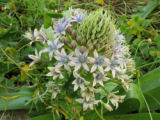
Family Description: Dioscoreaceae, commonly known as the yam family, is a group of monocotyledonous flowering plants in the order Dioscoreales, comprising about 715 species across 9 genera, with Dioscorea being by far the largest and most economically significant genus.
These plants are primarily twining vines or lianas, though a few are erect herbs. They grow from rhizomes or tubers, which are often large and starchy—making them important food sources in many tropical regions. The stems are typically cylindrical, sometimes winged or prickly, and may twine either clockwise or counterclockwise. Many species exhibit a distinctive atactostele—a scattered arrangement of vascular bundles in the stem.
Leaves are alternate or opposite, simple or palmately compound, often cordate (heart-shaped), and typically have 3–13 prominent basal veins. Petioles are long and often pulvinate at both ends, and stipules, when present, may appear as small spines or auricles.
Flowers are unisexual, and plants are usually dioecious. They are small, actinomorphic, and arranged in spikes, racemes, or panicles. The perianth consists of six tepals in two whorls, often petaloid and sometimes fused at the base. Male flowers have six stamens, though some may be reduced to three or even absent. Female flowers have an inferior, trilocular ovary with axile placentation, and typically two ovules per locule. The styles are three, either free or fused at the base.
Fruits are usually capsules, berries, or winged samaras, and seeds may be winged or unwinged, with endosperm and a small embryo. Many species also produce bulbils—small aerial tubers that aid in vegetative reproduction.
Family Description: Iridaceae, commonly known as the iris family, is a large and diverse group of monocotyledonous flowering plants within the order Asparagales. It includes around 66 to 80 genera and approximately 2,200 to 2,500 species, with a nearly global distribution but greatest diversity in southern Africa.
Members of Iridaceae are predominantly perennial herbs, though a few are evergreen or shrubby. They typically grow from underground storage organs—rhizomes, bulbs, or corms—which aid in vegetative reproduction and seasonal survival. Leaves are usually simple, linear to sword-shaped, with parallel venation and a characteristic equitant (overlapping) arrangement at the base. They are often isobilateral and lack petioles and stipules.
The flowers are actinomorphic or zygomorphic, bisexual, and trimerous, typically with six tepals arranged in two whorls. These may be free or fused into a tubular perianth. The androecium consists of three stamens, often epipetalous, and the gynoecium is inferior, tricarpellary, and syncarpous, forming a trilocular ovary with axile placentation. The fruit is usually a capsule, dehiscing to release numerous seeds, which may be winged or arillate.
Family Description: Liliaceae, traditionally known as the lily family, is composed primarily of herbaceous, perennial plants that often exhibit pronounced ornamental features. These plants typically possess specialized underground storage organs such as bulbs, corms, or rhizomes, which enable them to survive unfavorable periods and regenerate annually. The leaves are generally linear or strap-like, displaying parallel venation and a glossy, often glabrous surface. They frequently emerge in a basal rosette or alternate along an erect, unbranched stem, lacking conspicuous petioles.
The family is renowned for its showy flowers, which customarily exhibit a trimerous arrangement, with floral parts occurring in multiples of three. The perianth consists of six tepals—undifferentiated segments that are often brightly colored and arranged in two whorls of three, creating a visually striking display. The androecium is composed of six stamens, typically arranged in two whorls, featuring versatile anthers that release pollen with relative ease. Centrally positioned is a superior, trilocular ovary formed by three fused carpels that matures into a capsule or, in some cases, a berry, dispersing minute seeds.
( Catbrier Family ) Conservative synonym: Liliaecea
Subfamalies: nil.
Family Description: Smilacaceae is a family of flowering plants commonly known as the greenbrier family, and it is essentially represented by a single genus, Smilax. While older classifications recognized two genera (with Heterosmilax often segregated), modern molecular studies have merged them into Smilax, which now comprises around 210 species. These plants are generally climbing or twining vines with stems that are often armed with prickles or spines, aiding their ability to scramble through other vegetation.
The leaves are usually simple and alternate, typically showing parallel venation with reticulate patterns between the main veins in some species—a feature that sets them apart from many other monocots. Small, unisexual flowers are borne in clusters or umbels, and the fruit usually develops as a berry containing one to a few seeds. A notable characteristic is the pair of tendrils present near the base of the petiole, which assists in their climbing habit.
Found across tropical and warm-temperate regions worldwide, members of Smilacaceae inhabit a range of environments from dense forest understories to more open, rocky areas. Their distinctive morphology and ecological versatility have made them an interesting subject for both botanical research and horticultural observation.